How 3M Prestige works: light in, heat out
A film about 0.05 mm thick tells the light you want apart from the heat you do not. Here is how, without the marketing shorthand.
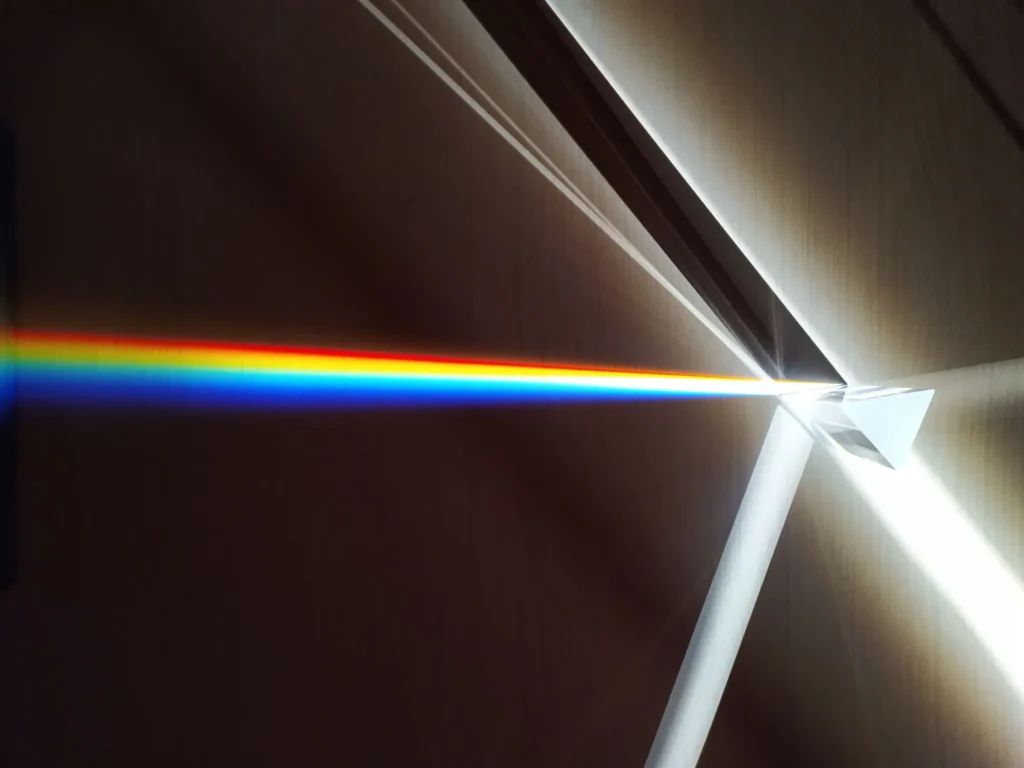
3M Prestige is a spectrally selective film. It is made of more than 200 layers of polyester and acrylic (PET and PMMA), each thinner than a wavelength of light. Together the layers act as an optical filter: they pass visible light and reflect infrared back outside. No metal is involved, which is why the window does not look like a mirror.
Solar energy has three parts
Ultraviolet, visible light and infrared all reach your window. We only see the middle one, but all three carry heat. Pick a band to see what Prestige does with it.
Energy shares by band: International Window Film Association, Advanced Solar Control Education Guide, 2023. Band limits differ slightly between standards.
Why the film is not reflective
Ordinary solar films stop heat with a thin metal layer. Metal reflects everything at once: heat, light and radio waves. The result is a mirrored look, a darker room and weaker signal.
Prestige relies on light interference in layers of plastic. It reflects mostly the infrared part of the spectrum and lets visible light pass. Bare single glass reflects 8 to 9% of light. With Prestige it reflects 5 to 9%, the same or less.
What “up to 97% infrared rejection” means
That is a 3M figure and it applies to a narrow band from 900 to 1000 nanometres. Solar infrared actually runs from about 780 to 2,500 nm, and visible light carries heat too. So 97% is not the share of heat the film stops.
The overall result is given by TSER, total solar energy rejected. On clear double glazing it is 42 to 76% depending on the film, against 30% for the glazing alone. When comparing films, always ask for TSER or the g-value on your type of glass, not an infrared percentage.
It rejects more when the sun is high
Table values are measured with the rays hitting the glass head-on. At midday in summer the sun is high and strikes a vertical window at an angle, and the layers then reflect more. The chart shows the difference between normal incidence and a 60° angle.
The 60° values come from US 3M data sheets (NFRC method, 1/4-inch glass). At normal incidence they differ from the European EN 410 data by no more than 2 percentage points. 3M does not publish angle data for Prestige 50 and 20 Exterior.
What the film does not do

- It does not insulate. The U-value of clear double glazing is 2.67 W/m²K with or without Prestige. On single glass it falls from 5.85 to 5.62 W/m²K, which is negligible.
- It reduces winter solar gain too. The film cannot tell the seasons apart. It cuts heat from the winter sun as it does from the summer sun.
- It does not stop fading completely. It blocks 99.9% of UV, but visible light and heat fade colours as well.
- It gives no privacy. Since it is not reflective, people can see in as before.
What it is made of
The carrier is multilayer polyester with acrylic and the adhesive is a pressure-sensitive acrylic. The surface is scratch-resistant, and the Exterior range has a tougher coating made for rain and frost. The US 3M data sheet states 220 microlayers, a total thickness of 0.051 mm and a Class A result in the ASTM E84 fire test.
According to 3M the film can become carbon negative as soon as 6 months after installation. That is a manufacturer calculation under the GHG Protocol with third-party assurance, not a measurement on a specific building.
Send us your window sizes and get a price as soon as possible
Glass area, window type and a few phone photos are enough. The site survey and the quote are free and non-binding.